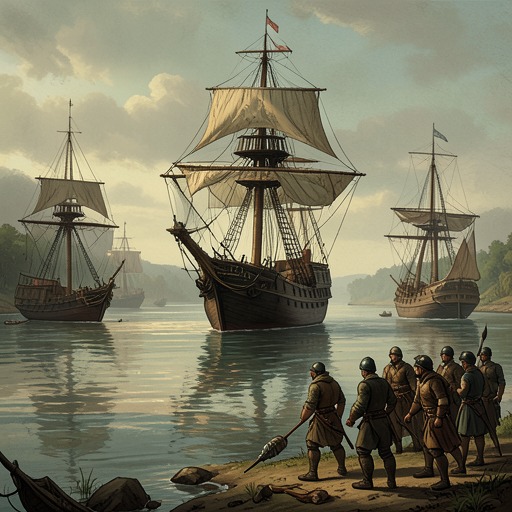
Xu Sheng
The Romance of the Three KingdomsXu Sheng is a commander in the service of Sun Quan whose resourcefulness helps protect Wu from Cao Pi’s invasion. His most consequential stratagem is a vast false defensive wall raised along the river in a single night: when Cao Pi sees it at dawn, he abandons the prospect of attack. Xu Sheng’s episodes also reveal the tensions within Wu’s command, where military discipline, royal clemency, and resistance to political submission pull in different directions.
Role and Military Character
Xu Sheng enters the account as a military commander entrusted with defending Wu. During Cao Pi’s invasion, he is assigned to the Great River, where he takes the defensive while Lu Xun guards Jingzhou. His orders reflect the immediate danger: Wei has prepared a combined land and naval force, and Xu Sheng must protect the river frontier against an enemy whose ruler is present with the fleet.
The narrative presents him as decisive about command and discipline. When Sun Shao, a young relative of Sun Quan, repeatedly demands permission to cross the river and attack with his three thousand men, Xu Sheng refuses. The repeated appeals become a challenge to his authority as well as a proposed operation he considers unauthorized. He orders Sun Shao’s execution as a warning to the army, but Sun Quan arrives before the sentence is carried out and intervenes.
The Dispute Over Sun Shao
Xu Sheng respectfully objects to Sun Quan’s intervention, explaining that sparing Sun Shao risks weakening military discipline and martial resolve. Sun Quan nevertheless pleads for the young man’s life, while allowing Xu Sheng to remove him from the army. The exchange sets royal authority against a commander’s concern for the coherence of military orders: Sun Quan preserves his relative, but Xu Sheng’s objection is not dismissed as mere personal anger.
The compromise does not end the problem. Resentful of his dismissal, Sun Shao takes his three thousand soldiers across the river without permission. Xu Sheng responds by sending Ding Feng after him, instructing the commander to keep the impulsive young man under observation. Xu Sheng thus tries to contain the consequences of Sun Shao’s defiance without abandoning responsibility for the wider defense.
The False Wall and Cao Pi’s Retreat
Cao Pi arrives at Guangling with an invasion force of more than three hundred thousand, including ten enormous dragon boats, each described as capable of carrying two thousand men, and three thousand warships. After being told that no enemy troops can be seen on the opposite bank, Cao Pi sails his state barge into the river to inspect the situation. His display of imperial regalia accompanies an expectation that Wu’s defenses may be absent or intimidated; Liu Ye, however, urges caution about crossing.
Xu Sheng turns that uncertainty to Wu’s advantage. He orders a formidable wall to be erected overnight along the southern bank. At first, darkness and heavy fog conceal the work. When the fog clears at dawn, Cao Pi’s force sees an immense fortified line stretching for about a hundred miles and guarded by a large army. The wall and its defenders are a deception, but the appearance is convincing enough to shape the enemy’s decision. Believing the position too strong to assault, Cao Pi concludes that there is no point in attacking and withdraws from the plan to cross.
The episode makes Xu Sheng’s achievement a victory of information and perception rather than a recorded clash of armies. The deception changes what Cao Pi believes he can safely do, and the scale of the apparent defenses counters the intimidation that might otherwise have accompanied Wei’s much larger force. The invasion is also unsettled by a rising wind that threatens Cao Pi’s dragon boat; Wen Ping intervenes to rescue him. As Cao Pi’s forces face this danger, further bad news arrives: Zhao Zilong and his men are advancing from Yangping Pass toward Chang’an.
Resistance to Submission and Narrative Significance
Xu Sheng also voices opposition to Wu’s political submission to Wei. When Xing Zhen arrives to deliver Cao Pi’s appointment documents, the haughty manner of his entry provokes protest from Wu’s officials. As Xing Zhen dismounts and offers Sun Quan respect, someone condemns accepting a title from Wei when Wu ought instead to destroy Shu and Wei. The speaker is Xu Sheng. His intervention exposes the distance between the ceremony of submission and the military ambition of Wu’s officers; the account indicates that Xing Zhen recognizes that the submission will not last.
Across these scenes, Xu Sheng’s role is defined by the pressure he places on both military and political appearances. He insists that command must mean something when Sun Shao challenges it, yet he uses a manufactured appearance of strength to prevent Cao Pi from testing Wu’s defenses. He objects when Wu accepts a subordinate title from Wei, even as Sun Quan seeks the strategic advantage of that arrangement. The false wall is his clearest triumph: faced with an overwhelmingly large invasion, he gives the enemy a reason to turn back without a battle.